Thursday, 18 August 2016

Support the women in your life

As we continue to celebrate Women's Month, it's a good time to focus on the glue that binds not only women but people together – solidarity. This can mean many things to different people, from active participation to silent support. However, what I'd like to highlight are some of the ways that we can show solidarity with each other by inspiring and supporting the women in our lives.

First, look at yourself

There's nothing so humbling as taking a good long look at ourselves. It's also terribly important that we do this if we are to live and act with integrity. What we also find when we honestly know ourselves, is that we develop more empathy. We recognise where we have fallen short, and can imagine how it must feel for others. This can help us to identify more with other people, and be more supportive of the women around us, rather than being judgemental.

The other benefit of this is that it allows us to recognise your own prejudices and biases. Once we recognise these we can work towards eliminating them.

Support, rather than compete

We should all, hopefully, realise that in our modern society we are still working to overcome centuries of patriarchy and that one of the effects of this is that women usually have to work harder for fewer places at the top than do men. This obviously creates more competition.

However, it's vitally important that, as we compete for career opportunities, we don't adopt a constantly competitive attitude towards the women with whom we work. There is always plenty of room to be supportive of our colleagues, even if it means giving them the glory. An attitude like this will pay more dividends in the long run, not least because it will make you more persuasive and effective with the people around you.

Show appreciation

There are few things as inspiring as feeling that we are appreciated. That what we have said or done was worthwhile, and acknowledged as such by others. On the one hand, it's a stroke for the ego, of course. On the other, it's an important part of self-validation.

This gives the simple act of showing appreciation a very powerful effect – one that we should try to use as much as we can. This can range from a simple thank you to a bunch of flowers or a glowing endorsement in an email.

Learn from each other

These days we rely on the education system so much, along with corporate and other training, that we start to forget that each one of us can be a teacher to someone else. Passing on skills, wisdom, tips and tricks from one person to another is still the most effective way of developing knowledge and ability. So let's take every opportunity we can to pass on our own knowledge and skills to each other.

Take and promote accountability


This might not seem like an obvious way to inspire people but bear with me. When we learn to take accountability for our lives, we start to feel more self-empowered and in control. Not only that but when we feel an accountability to other people, we tend to think and act in more community-spirited ways. Lastly, having other people to whom we are accountable gives us a source of objective opinions about our performance and development.

So let's encourage each other to be accountable for ourselves in all aspects of our lives, and help to serve as accountability barometers for each other.

How do you support the women in your life? Tell us here, or tweet us on https://twitter.com/EduloanSA

Thursday, 11 August 2016

South African women making a difference


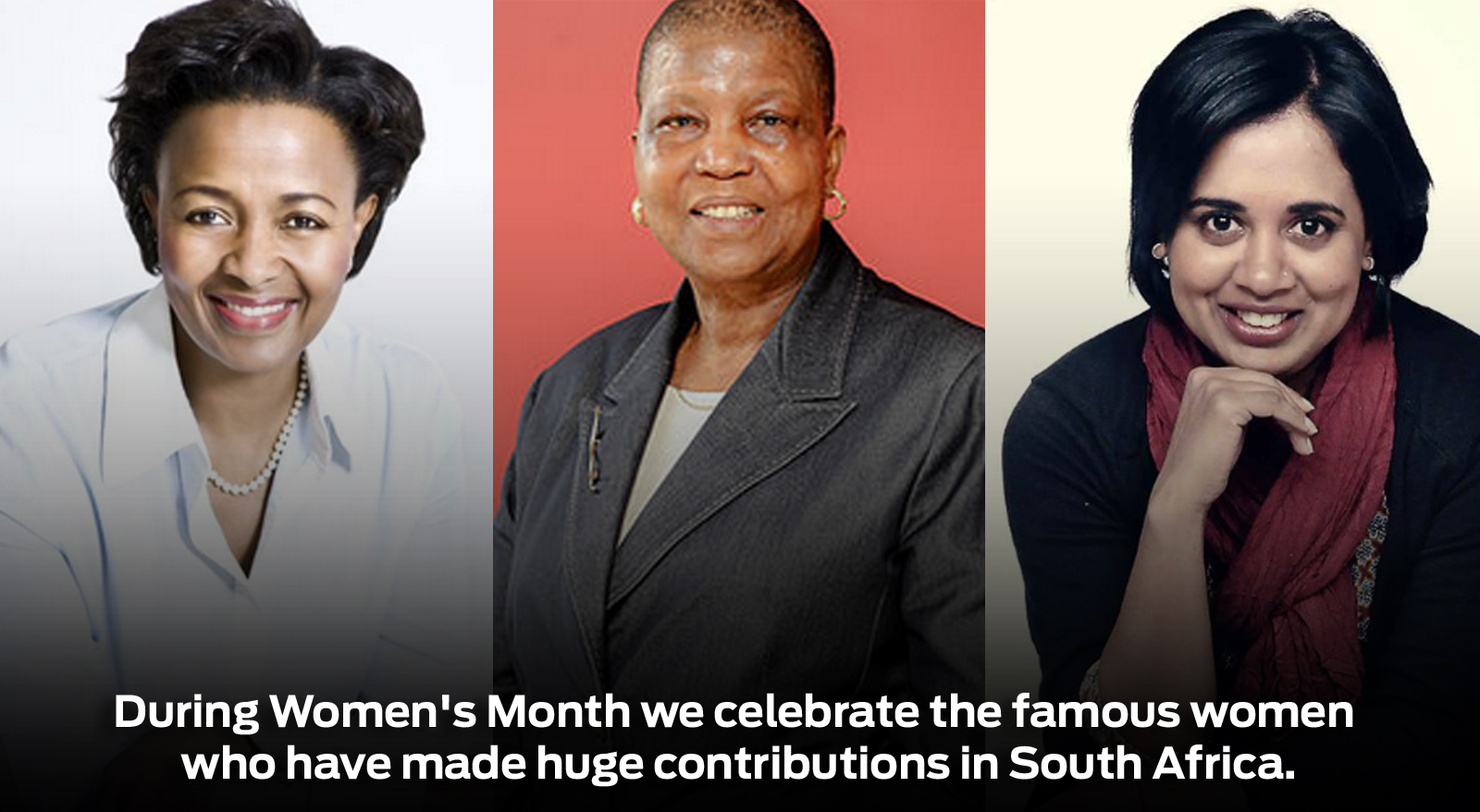
When we celebrate Women's Month it's customary for us to look to eminent South African women who have made significant achievements. The same people are usually on lists of influential women: Thuli Madonsela, Dr Nkosazana Dlamini-Zuma, Charlize Theron, Bridgette Radebe, Natalie du Toit, Maria Ramos... we know their names.

So in this Women's Day article I want to focus on three hugely influential women who aren't necessarily household names to the same extent.

Wendy Luhabe

Wendy Luhabe's significance lies not in the fact that she is one of the most powerful businesswomen in the country who has gone on to become Chancellor of the University of Johannesburg. It's her work as a social entrepreneur that sets her apart.

Although rising to the highest levels of business in South Africa, having being chair of the Vodacom Group, she has found the time to start and maintain organisations dedicated to the empowerment of previously disadvantaged women.

She started her Bridging The Gap consultancy back in 1992, the aim of which was to impart skills to previously disadvantaged women to help prepare them for the business world. Two years later she launched Wiphold, a women's investment holding that has become a vehicle for tens of thousands of first-time women investors. It also became the first company solely owned by women to be listed on the JSE.

She then began a new private equity fund for women-owned businesses and has written a book life and business coaching book, Defining Moments all profits from the sale of which go into a fund for the upliftment of women.

Salukazi Dakile-Hlongwane 

Salukazi Dakile-Hlongwane is an unassuming career economist who has dedicated her career to women's development in Africa. It's a cliché to point to humble beginnings, especially when they are so commonplace in our country, but it's once again true of Dakile-Hlongwane. Her father was a civil servant and her mother sold dresses in their Soweto neighbourhood.

It was education that opened all the doors for her. She went to school in Lesotho and then to university in the USA, majoring in development economics. She then founded Nozala investments in 1996, along with Jean Ngubane and Dawn Mokhobo, aimed at women's economic advancement. It has supported 10 women's empowerment groups since then, and controls a trust that helps people to start businesses in impoverished areas.

She has also worked for the African Development Bank, SADEC and FirstCorp, and is a director or MultiChoice Africa.

Yogavelli Nambiar

Not a name that many people know, but Nambiar has spent decades deeply involved in social entrepreneurship – specifically helping to meet one of the most pressing needs of our developing economy: starting and sustaining small businesses.

She is currently the founder of the Enterprise Development Academy at the Gordon Institute of Business Science (GIBS) and the University of Pretoria Business School. However, this just scratches the surface of her contribution to education in this country. Her focus at GIBS is on providing scholar-ship based business education and support to small business entrepreneurs. In just over two years her unit has worked with over 1 000 entrepreneurs, from IT start-ups to spaza shops.

Previously in her career she was a member of the team that developed our country's National Youth Development Strategy, and the working group that created the Code of Governance for the non-profit sector of South Africa.
 
Which women do you think should be household names? Tell us here, or tweet us on https://twitter.com/EduloanSA

Friday, 5 August 2016

Celebrating South African women


We celebrate Women's Day on 9 August each year, yet most of us only have a vague idea of what the principles are behind it. We know that it's about recognising the role that women play in our society and in our lives, as mothers, sisters, wives and daughters. We perhaps also understand that there's a feminist or anti-apartheid aspect to it, mostly through the posts we read from our friends on Facebook.

So we thought we'd take a closer look at the reasons why there is a Women's Day, and why as we celebrate we also need to remember the very real challenges that women face in our society because of their gender.

Why is there a Women's Day?

First we should note that there is a difference between International Women's Day, which falls on 8 March every year, and National Women's Day, which is specific to South Africa.

Our National Women's Day commemorates the women's march to the Union Buildings in Pretoria in 1956, in protest against the repressive Pass Laws. Women from all across the country marched, led by four stalwarts of the women's movement and the anti-apartheid struggle: Lilian Ngoyi, Helen Joseph, Rahima Moosa and Sophia Williams-de Bruyn.

These women and their various community organisations organised a march of this scale in an era without the Internet, without WhatsApp, without cell phones – sometimes even without access to landlines. Messages, instructions and organisational details were spread around the country by dedicated people driving to the most remote regions.

On the day, over 20 000 women arrived from across the land, each one with a strong understanding of why they were there. Besides the march being by default an anti-apartheid event, it was aimed particularly at the proposed extension of the notorious Pass Laws to women, which would have made it even more difficult to work and raise their families. A petition was left outside the office of JG Strijdom, the then prime minister – he had refused to accept it in person.

The march became most important mass mobilisation of women in our history, and for this reason we commemorate it each year.

That's the celebration part.

Women's Day and the girl child in South Africa

The other reason why we commemorate Women's Day, is to remind ourselves and others of the enormous challenges that still face the girl child in South Africa. Women's Day is also about focusing on these issues in a continual effort to remove them.

The most obvious and, to be honest, horrific reality facing the girl child is the threat of or actual physical harassment, abuse and violence. Our country has a relatively high level of these maladies and eradicating violence and abuse against women is and must remain a national priority.

The girl child is also vulnerable to the consequences of teen pregnancy, particularly the interruption of her education. Education is such an important aspect of our developing country that this can have a lifelong negative effect on the woman. Proper, accurate and widespread sexual education and access to contraception still needs to be rolled out more comprehensively across our country.

It also often falls to the girl child to play the role of surrogate mother in the home, especially due to the AIDS pandemic. These girls have to deal with the dual disaster of becoming orphans at an early age, and having to look after their siblings. We need to create far more effective support systems for these young girls.

There are many other issues facing the girl child and women in general in our society, but the final one I'd like to focus on is the patriarchal system itself. Many of our cultural norms are still biased against women, because they come from an outdated era before we developed the more sophisticated human values that we now emphasise. Women from all walks of life will tell us of everyday incidents that underline the extra challenges that they face compared with men. For example, the automatic assumption that an engineer we are going to meet will be male, or the way we encourage boys to be scientists more than we encourage girls.

So let's all use this Women's Day – in fact, this entire Women's Month – to remember the values that the courageous women of 1956 marched for, and to concentrate more than ever on removing the unequal obstacles that women still face in our country.

How do you think we can honour Women's Day and create a better society for women? Share it with us here, or tweet us on https://twitter.com/EduloanSA.

Thursday, 28 July 2016

Think long-term - really long-term


We're often told that we should plan ahead. This takes on new meaning when we put it into a really long-term perspective, like thinking about the kind of society we want to create for the next generation.

It's one thing to plan for one's own future, and even for our children's future, in terms of things like education, but it's a lot more difficult to plan how their lives will turn out. There are so many different social and environmental factors over which we ultimately have no control.

So how can we think ahead and prepare a future for the generations that will follow us, without being able to really plan for what will happen? The best we can do is to try and influence our immediate communities so that through them we can create the kind of society we want future generations to inherit. The most effective way to do this is through our own individual behaviour, so here are a few ideas.

Get involved in community organisations

It doesn't matter where your personal priorities lie, you should be able to find a community organisation that fits your needs or suits your interests. These organisations are in many ways the backbone of our communities because they play central roles in people's lives. By participating in them you will be able to make a very direct and meaningful contribution towards building a future society.

Two of the most obvious organisations that you might want to get involved with are a church or a sports club. We South Africans love our sport, so finding a sports club near to where you live shouldn't be a problem. If you're young and fit enough you'll obviously get the most benefit from actually playing the sport. If your playing days are over you could coach the kids. Otherwise, you can help in another capacity – most sports clubs have administrative committees to run them.

Similarly, religion plays a central role in the lives of many people in our country, so finding a church to join will be easy. There are plenty of service roles that you can fulfil in a church, from singing in the choir to youth counselling.

Become politically active

There are many ways to become involved at a political level in our society, and only a few of them involve being a politician. You can get involved in fundraising for your preferred party, or join its local branch. If your focus lies on a specific issue, like LGBT rights, for instance, you can join an organisation that represents this focus. Being politically active simply means doing something concrete for something that you believe in.

Help to educate others

Not everyone is called to be a teacher, but each one of us can pass on our knowledge, skills or experience to others in our own way. So whether at work or in our community organisations or interest groups, we should try to identify younger or newer members who we can help along by passing on what we have learned and what we can do. Sometimes it might simply be a case of sharing some life wisdom with another person. The aim of it all is to help those who come after us to develop more quickly and more thoroughly.

What ideas do you have for thinking really long-term? Share it with us here, or tweet us on https://twitter.com/EduloanSA

Thursday, 21 July 2016

Real leaders focus on personal development


Most of our studies and career development course focus on the specific knowledge and skills we need to do our work. There has always been a very strong emphasis on these so-called "hard skills", and with good reason - these skills are paramount if we're to do our jobs properly.

In recent years, however, there has been more of a recognition that we need all manner of other skills to work effectively, perform optimally and get satisfaction from our jobs. These are the "soft skills", like interpersonal relationships, for example - how well we work with our colleagues.

As a result of this recognition, it has now become virtually par for the course that the development of soft skills is an important part of grooming future leaders. They need to have the skills to deal effectively deal with the people who they manage. Not only this, but they need to pass on these skills to others so that everyone in the organisation can benefit.

The importance of balance

Whereas previous incarnations of our societies didn't pay much attention to the so-called "touchy-feely" side of work, we have now realised that we also need to consider these aspects when striving for a healthy work-life balance.

If we don't create a proper balance in our work lives we run the risk of becoming less and less productive. That's why organisations place such an emphasis on the softer skills.

It's the responsibility of leaders to teach those they work with about personal development and how to deal with life issues and the work-life balance.

Career growth requires personal growth

Have you ever noticed that most of the people who seem to cope with work without breaking a sweat, who never seem stressed and who always seem to have enough time to get everything done are the most experienced people in the organisation?

That's because they have learned - often through trial and error - how to work efficiently. They have developed personal characteristics that allow them to perform well under pressure, without suffering in their personal capacity.

This means that in order to do our work as effectively as possible - both for the company that employs us and in order to be healthy and happy - we need to develop specific skills. Among them are perseverance, calmness, patience and empathy.

In short, to grow in our careers we need to grow as people too.

What organisations and leaders can do

Good leaders are able to teach these life skills to the people, both by mentoring them and by being observable examples. Companies that are seeking sustainability and growth need to put in place formal structures that allow leaders to accomplish this.

The next generation of leaders needs to be identified early so that they can be put onto a company programme of personal development and growth, facilitated by the company leaders. Leaders themselves should be trained to be constantly cognisant of the importance of this personal development mentorship so that they are able to take advantage of opportunities to pass personal skills on at any point in their interactions with the people they manage.

We have seen time and again that the most worthwhile investment an organisation can make is in the development of its people - to the extent that it becomes a no-brainer. It is the leadership that needs to drive this.


What do you think leaders should teach? Share it with us here, or tweet us on https://twitter.com/EduloanSA.

Thursday, 14 July 2016

Real leaders create other leaders

An old Japanese proverb holds that the mark of a master is how many other masters he creates.

There are lots of cliches about leadership. We hear that the best leaders lead from the front. That they lead by example. However, perhaps the most important role that leaders can play when it comes to creating sustainability, consistency, and growth in society is captured in Tom Peters' now famous quote: "Leaders don't create followers, they create more leaders".

The importance of continuity

Society needs continuity. Its policies, projects, initiatives, businesses - even its norms and values - need to be carried through from one generation to the next. If this doesn't happen, there is too much volatility for society to bear. We won't be able to sustain anything. We won't be able to think and act in a long-term fashion. We won't be able apply planning. We'll effectively be winging it from one generation to the next.

This is why it's so important for each generation of leaders to identify and nurture the next wave of leadership. The next group of people who will lead their companies, teams, schools, universities, communities and the country, building on what has been created before. The baton needs to be passed if we are to avoid stagnation, and grow to our full potential as communities, economies, and countries.

How do we create leaders?

There are many ways in which we can inculcate leadership - advanced education, training programmes, skills development initiatives and the like. However, there remains an age-old method that is still highly effective. In fact, it could be argued that this is the most important factor in creating true leaders. This is mentorship.

Mentorship is how we have traditionally created leaders in our societies, although we used to call it an apprenticeship. From ancient tribal customs to the most modern leadership development approaches; this has been the common thread.
Leaders will take selected people under their wings, so to speak, mentoring and grooming them to take over leadership positions one day. Knowledge and wisdom are passed on, and skills and expertise are taught. The apprentice is shown how to think like a leader. How to develop a leadership psychology. This can really only happen through interpersonal contact - working closely together in a mentor-mentee scenario.

Future leaders also need to gain as much hands-on experience as they can. It's a big step to take from only having to be responsible for your own work to being responsible for the output of others. This means giving your future leaders as many opportunities as possible to practise and develop their leadership skills.

Most important is the leadership mindset. Leadership requires a very different mental attitude. Future leaders need to learn that it is necessary to accept accountability - even if they are not directly responsible for something. They need to develop an attitude of "the buck stops here".

This is quite possibly the most important aspect of leadership that we need in this country at the moment. It's the attitude we need in our leaders if we are to face our challenges successfully - nothing ever gets done properly if everyone passes the buck. A strong leader doesn't do this.

Do you think we do enough to develop leadership? Share it with us here, or tweet us on https://twitter.com/EduloanSA

Thursday, 30 June 2016

Have you thought about your tertiary education?


If you're entering your last couple of years of school or are already in Matric, chances are you'll have given some thought to what you want to do after school, in terms of a career or studying further.

Some people are lucky in that they have had lifelong career ambitions; they know exactly what they want to become and what to study to achieve this. However, most of us enter our final years of school not quite knowing what career we want.

How are you feeling about your own future? Here are some things to consider when planning your education.

Get career advice

The smartest thing to do is to match your studies to your career ambitions. Of course, to do this you need to decide what career you want to follow.

One of the best ways of doing this is to attend any career functions that your school organises. They usually bring in different career professionals to talk about what they do and advise you on what to study.

Your other option is to go for some kind of career guidance counselling. There are plenty of people who specialise in exactly this, so it's simply a matter of making an appointment. You'll typically fill in some aptitude questionnaires and have a short interview, after which you'll be given a report on the kind of careers that would suit you best.

If you still have no idea what career you wish to follow, getting a tertiary education is still important, as it creates a solid basis on which to build any career, and any further studies you may want to pursue. Try to choose a course that will leave you with options, like a general degree in communications, for example. The idea is to keep as many career doors open as possible.

Do your research

Whether you know exactly what career you want or only have a vague idea, you need research the courses that you could study in order to prepare yourself.

Some careers have well-defined educational paths, so one simply follows the curriculum as it is set out. These are usually the professional careers, like those in engineering or the legal world. If you decide on a career like this, your educational path will be clearly set out for you.

If you want to pursue a career that doesn't have such a clearly defined study curriculum, it's a case of choosing a course that will teach you the theory and nitty-gritty of the career arena that you want to enter. So, for example, if you want to become a media entrepreneur, you can choose courses from a wide range that will give you a solid basis. This could include topics like communication, media studies and politics, depending on your particular field of interest.

Speak to people who are already pursuing the careers you are interested in - find out what they studied, or what they would recommend that you study. Research courses online, to find out which ones will best further your career ambitions.

Plan an educational path

Now that you have an idea of what type of studies to pursue, you can start to plan your actual courses. You may want to start with a short introductory course to get the feel for the subject, in case you're still not entirely sure what you want to do with your life.

Once you've orientated yourself to the study direction you want, you should plan what your main qualification will be, to begin with. Do you want to study for a university degree, or will you only need a college certificate? Can you do some sort of mentorship that will lead to you studying for a tertiary qualification?

In other words, you need to get a clear idea of what qualifications or certifications you will need in your chosen career. Build up a view of all the possible education options that relate to this career, and create an educational plan for yourself. You don't have to do it all at once - you may find that it will be best to get a basic qualification, then get some work experience before studying further.

Remember, you can control your career through your educational choices. Put a plan in place for how you will get the qualifications you need and you'll find that your career path will be all that much smoother.


Do you have a plan for your education? Share it with us here, or tweet us on https://twitter.com/EduloanSA